Showing posts with label Traditions. Show all posts

Saturday, December 17, 2016

Christmas Update

At the beginning of December, I posted this post on our family Christmas traditions. I said I’d be posting more posts about how our traditions are going but honestly have not made time for it because I’ve been enjoying Christmas time so much! This one will probably be the only one I do before Christmas.


Our daily Christmas Devotionals have brought the Christmas spirit into our home and family more quickly and more powerfully than any year before! Every time someone asks me how I'm doing, I enthusiastically say I'm doing great and that I love this time of year. I find myself telling everyone how awesome our Christmas Devotionals are! I hope I don't come off as bragging—I just want to share it because it's making us so happy. It has been so wonderful to sing worshipful Christmas hymns each day and read scriptures together each day and set goals to serve people each day! I’ve learned that singing sacred music before reading scriptures really helps us kids get into scripture study more.


Also, our Church is doing this amazing Advent social media campaign called #LightTheWorld. It complements our Christmas Devotionals so well because each day there is a video that highlights something Christ did and how we can do it too in our own way! We’ve added these 30 second videos to our daily devotionals and have used the theme of each one to inform the gift we give the Savior that day.


The greatest blessing that has come of this is watching our kids get excited about doing good things. When the daily theme was “Heal the Sick”, one of our children chose to take all of the money in his little bank and give it to Primary Children’s hospital. When the theme was “Clothe the Naked”, one of them went and got some clothes and wanted to give them to people who don’t have clothes. One child likes to hold the baby Jesus from the nativity while we sing the daily Christmas hymn and always says, “I help Jesus” when we ask what gift we’ll give to the Savior each day. Seeing them do these things is such a blessing because they are doing them of their own accord.


Through all of this, I am reflecting a lot on Ebenezer Scrooge and how Dickens said that he learned to keep Christmas all year long. I wonder if there are aspects of our Christmas Devotionals that we should do even after Christmas is over. I don’t want them to become cliché or too normal for our kids so I think we’ll definitely have some aspects of the devotionals that are unique to December but maybe we can sing before scripture study all year long and maybe we can set and report on goals with scripture study somehow the rest of the year.

How have your Christmas traditions gone this year? What do you think it means to keep Christmas all year long?

Thursday, December 1, 2016

Christmas Traditions

The Christmas season is such a magical time. There is something special in the air that makes me feel wonderful. But, of course, it isn’t special just because the calendar says December. There isn’t some arbitrary special feeling that comes upon people once a year because of the earth’s position in relation to the sun. It’s special because of how we as individuals, families, and a society act and think differently at this time of year.

That said, during our first three years of marriage, Jamie and I had to fight each year to “feel the Christmas magic”. It would get to be halfway into December and we’d realize that we felt terribly normal. We yearned to feel that special something during Christmas. Each year, we’d pray for help to feel the Christmas spirit and then we’d be lead to serve someone in need and worship Christ in some special way and then that special Christmas feeling would come.

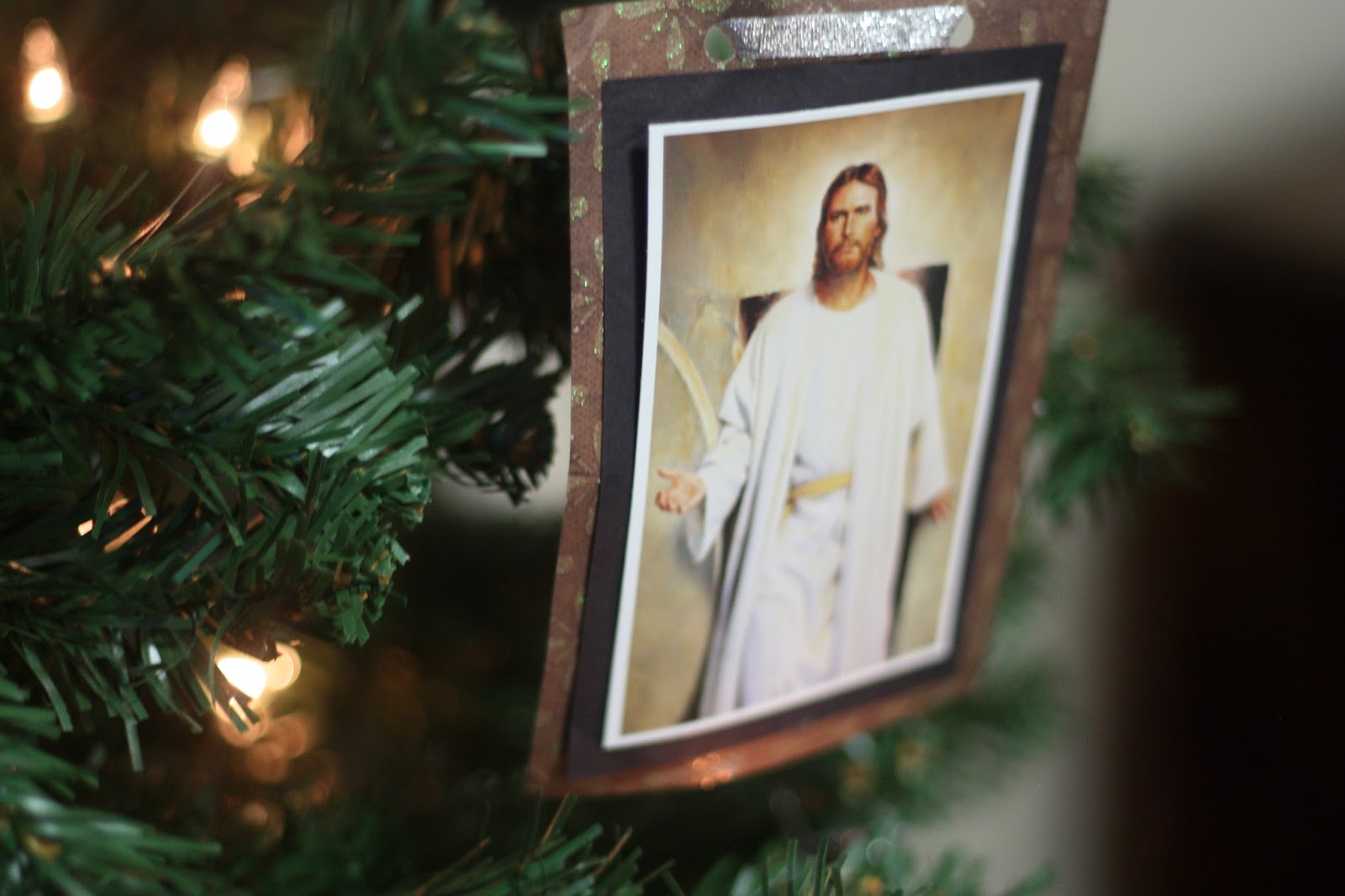
After a few years of this, we learned our lesson and decided it was time to institutionalize some family Christmas traditions focused on service and on Christ. We began what we call our “Christmas Devotionals”. We made 30+ tree ornaments that each have a Christmas hymn on them as well as a scripture. The scriptures are segments of the Christmas story in the New Testament or prophesies from the Old Testament or Book of Mormon about Christ (you can read the list of scriptures and hymns we use here). We also bought an inexpensive notebook we use as a Christmas diary.

Each year, soon after Thanksgiving, we decorate our home for Christmas. We put up the Christmas tree but intentionally leave it just a little sparse with ornaments. Then, each evening until Christmas, one of the kids picks one of the special ornaments we made. We sing the Christmas hymn on it and read the scripture. Then, we get out the Christmas diary and each write down one thing we’ll do the next day to give a gift to the Savior. The gift is often in the form of helping others in some way. The next night, as we do the devotional, we talk about how it went giving those gifts and write down new ones.

We’ve learned from experience that the actions we do to give gifts to Jesus is the key to the whole thing bringing the Christmas spirit. One year, we decided to just do the hymn and scripture and skip writing down the gift. We wanted to speed up the process to accommodate small children. But we found that, without the commitment to action, we didn’t feel the magic of the season like we wanted. To go from hollow to holy, we had to not only sing and read scripture but also give of ourselves.

Other traditions have also helped us focus on Christ at this time of year. For example, we try to involve our chidren each year in giving gifts to a family in need. Jamie and I have a tradition of saying we’ll read Charles Dickens’ A Christmas Carol each year. We have a tradition of not doing so each year—but this year will be different….

Personal traditions are great too! I like to dedicate my December personal scripture study to reading one of the New Testament Gospels or the “Fifth Gospel” in the Book of Mormon (which tells the story of Christ’s post-resurrection visit to the Americas). I rotate through one Gospel each year. I enjoy reflecting on Christ’s life, example, and sacrifice each December to remind me why His birth matters so much. Now that I’m blogging more, I’ve decided to try out a new tradition. For the month of December, I’ve revamped my blog to add some Christmas cheer and I’ll be posting short reports on special experiences we have as we go about our Christmas traditions.

Of course, it’s good to have Christmas traditions that are just fun too! We like to give gifts of course. We watch Home Alone together each year along with the Doctor Who Christmas Special. Every year, I like to welcome in the season by posting the funny parody video on Facebook. Fun and joy and laughter are part of the magic of Christmas along with service and Christ. But we’ve found that putting Christ (which includes serving Him and His children) at the heart of our festivities animates and quickens all the other pleasantries of the season.*

I hope this blog post will start a helpful thread of sharing tradition ideas with one another. So, please comment: what Christmas or Holiday traditions do you have? How do they help you feel the magic of the season?


*This makes me think of a prophetic quote given in a 1988 Christmas address, “...men and women who turn their lives over to God will discover that He can make a lot more out of their lives than they can. He will deepen their joys, expand their vision, quicken their minds, strengthen their muscles, lift their spirits, multiply their blessings, increase their opportunities, comfort their souls, raise up friends, and pour out peace. Whoever will lose his life in the service of God will find eternal life” (Ezra Taft Benson, “Gifts and Expectations”, Ensign, December 1988). I highly recommend reading the entire article.

Saturday, November 19, 2016

Why a Weekly Holy Day?

A couple of weeks ago, I posted this post about how Sunday is the eighth day of the week. To sum it up quickly, Sunday was the eighth day to early Christians because it was the day after the Sabbath (the seventh day). Sunday was a weekly holy day called "the Lord's Day" when they commemorated Jesus rising from the dead on the day after the Sabbath.

Whether we call it the Sabbath or the Lord's Day, we need a holy day each week. The Lord commanded it on Sinai, reiterated that command in our era, and set the example by resting Himself. But, as with all of His commandments, He doesn’t ask us to do this because He needs it but rather because He knows we need it. Jesus said, “The sabbath was made for man, not man for the sabbath.

Why do we need a weekly holy day? I discovered a trilogy of short videos that feature one of Jesus’ apostles addressing that very question. I especially enjoyed the second installment (embedded on this page) that talks about the symbolism of the hexagram (Star of David).


I personally love how the doctrine of a weekly Sabbath leverages the power of scheduling to our spiritual benefit. Schedules are powerful things. I go to work at a certain time each day and leave work at a certain time each day because my employer has established a schedule that I have agreed to. Work gets done because of that schedule. Before the internet, people faithfully tuned in for their favorite shows each week because of the power of routine scheduling. Most people wake up and go to sleep and eat at certain times for the same reasons. Stuff gets done because of routines and schedules. The Lord understands this and leverages it to help us devote at least 1/7 of our time each week to our spirituality. When we do this week after week after week, it has profound positive effects on who we are.

Also, the Sabbath helps us avoid the love of money. Our society measures the strength of our economy by the status of the stock market. A company’s stock is considered strong when it is making more money. Having consistently enough or sufficient for one’s needs is considered failure. We’ve accepted as status quo that one needs to relentlessly grow the bottom line and always have more and more money to be successful.

But the law of the Sabbath invites us to choose to make less money. We show our devotion by not working one day a week and not requiring others to work either. In the Old Testament, there was even a Sabbath year every seven years when the people were not allowed to make a profit on the land, were to forgive debts, and were let the poor and the stranger take freely of the fruit of the field. The focus wasn’t on extracting all they could get from the land but on taking a little less, being content with enough, and helping others. I believe the Lord would like for companies (even factories that “need to produce all seven days”) to close one day a week if, for no other reason, than to remind employers and employees that it is good to let go of growth obsession and be OK with sufficiency and learn to intentionally forgo profit to do the right thing.

Finally (and this relates back to the power of scheduling), the Lord’s Day is a weekly opportunity to remember Jesus Christ. We don’t have to wait until Easter to celebrate the Resurrection. Every Sunday is a celebration of that Miracle of miracles that happened on the eighth day. Every Sunday is a chance to participate in the Lord’s supper as He commanded in remembrance of the body and blood He gave for us. The words of the prayer associated with this Communion say that those who partake will “always have his Spirit to be with them” as “they do always remember him”. Devoting an entire day to celebrating Jesus’ Atonement and Resurrection not only helps us remember Him that day but reorients us toward remembering Him all week long which allows us to always have His Spirit with us. That Spirit is grace which works on us and changes who we are and makes us into new creatures who reflect who He is.

Monday, October 31, 2016

The Eighth Day of the Week

http://www.lovethispic.com/image/47307/eighth-day-of-the-week
Is Sunday the first day or the seventh day of the week? Most American calendars position it on the far left of the page, putting it first, but since Monday is the day most of us go back to our usual routines, Sunday can feel like the very end in weekend and therefore the seventh day. But I like to bypass this dichotomy and think of Sunday as the eighth day. Let me explain.

In Old Testament scripture, the Seventh Day is called “Shabbat”,  a word that comes right out of the Genesis creation account that simply refers to the idea of “rest” (sources here, here, and here). The common English rendition of “Shabbat” is “Sabbath”. The Spanish word is “sábado” which is also the common word for “Saturday” but the Spanish for “Sunday” is “domingo”, a word that comes from a Latin phrase that means “the Lord’s Day”.

You see, early Christians referred to the Saturday “Sabbath” separately from the Sunday “Lord’s Day”. The Sabbath was an Old Testament commemoration of the Creation (and the deliverance from Egypt) while the Lord’s Day was a weekly commemoration of the day Jesus rose from the dead and since Jesus rose on Sunday, the day after the seventh day, the Lord’s Day was considered to be the eighth day.

The early Christians emphasized an eighth (rather than first) day because they saw symbolism in the number eight. In addition to pointing to the day of the Resurrection, the number “888” is the sum of the Greek numerical values of the letters in Christ’s name. There are eight phases of the moon and all of these phases together make up a resurrection cycle and serve as a symbolism of God’s light increasing gradually within us line upon line, grace upon grace. “Seven” is all about completing things (like the Creation) while “eight” is all about starting new things which is what Christ did when He atoned and brought in the New Testament and the possibility of redemption from death and sin. And this is just the beginning—Steve Reed over at ldsSymbols.com has compiled a pretty comprehensive list of the significance of the number eight and how this number is symbolic of Christ Himself.

So, I like to think of Sunday as the eighth day or “Christ’s Day”.

Now, back to the early Christians. At some point, Christendom stopped referring to the Sabbath and the Lord’s Day separately and combined them together into one weekly holy day held on Sunday. Most Christian sects now accept Sunday as the Sabbath but there are a few that contest this and make a big deal out of it. Really, though, whether it’s the seventh day or the first day or the eighth day isn’t nearly as important as the fact that God wants us to set aside one day of seven to Him.

And the promises for doing so are huge! For example, see this revelation on the Lord’s Day given in 1831 which includes phrases like “unspotted from the world”, “thy joy may be full”, and “the fulness of the earth is yours”. Isaiah said that those who “call the sabbath a delight” will “ride upon the high places of the earth” and be fed “with the heritage of Jacob”. Jesus Himself said, “The sabbath was made for man, not man for the sabbath.


The Lord’s Day is for us and this comes back to final point about the eighth day—the math doesn’t add up. Giving the eighth day of seven to the Lord is mathematically impossible and I love that because the math has never added up with the Lord. When I think I’ve given my all to God, I somehow discover there is more of me. And thus it is with time. When we give one day of seven to God, we discover there are actually eight.